Maine Breast Cancer Coalition
Service :: Advocacy :: Education
Our Role
We advocate for important initiatives for research, treatment, and an end to breast cancer.
To find out more about current issues in breast cancer advocacy and legislation visit the National Breast Cancer Coalition web site at www.breastcancerdeadline2020.org.
For the latest facts about breast cancer from the National Breast Cancer Coalition www.knowbreastcancer.org.
Advocacy
Think BEYOND Pink

November 2015
Every year, as Breast Cancer Awareness Month begins and the wave of pink floods my inbox, mailbox, TV screen, Facebook wall and store shelves, I cringe. This year, I have lost six friends to breast cancer. In the past three weeks, I have received more than a dozen resource requests from women newly diagnosed with breast cancer in the rural county I serve in northern Maine. What is going on? How can this be happening? Haven’t all of these pink ribbons fixed this problem yet? On the contrary, breast cancer incidence is increasing and, despite small adjustments to treatment regimens, years of campaigns to raise awareness, ever-expanding screening programs, increased fundraising efforts and research, incidence and mortality have not changed significantly.
In the United States, breast cancer is the second leading cause of cancer death for women, after lung cancer. The chance of a woman developing breast cancer during her lifetime has increased from about 1 in 11 in 1975 to 1 in 8 today. Approximately 40,290 women and 440 men will die from the disease in the US in 2015, and it is estimated that 231,840 new cases of invasive breast cancer will be diagnosed in United States women, and approximately 2,350 among the men. (ACS, 2015)
Worldwide, breast cancer is the most frequently diagnosed cancer in women and the leading cause of cancer death among women. In 2012, we lost more than 522,000 women worldwide to breast cancer. That’s more than 1,400 women each day. (GloboCan, 2012)
The lack of progress is not due to insufficient resources for research.
· Since 2001, the National Institutes of Health has spent roughly a $2.8 billion on breast cancer research.
· The Department of Defense Breast Cancer Research Program (DOD BCRP) has allocated over $3 billion to peer-reviewed breast cancer research since 1992.
· Susan G. Komen for the Cure has spent close to $2.5 billion on research since 1982.
· The American Cancer Society has funded $86 million of breast cancer research in their multi-year portfolio.
· Since 1999, the Avon Foundation for Women provided more than $175 million to breast cancer research programs.
· Since 1993, the Breast Cancer Research Foundation has funded more than 9.5 million hours of breast cancer research.
More than 40 years and billions of dollars have not ended breast cancer. It has, however, created a robust cancer industry that thrives on raising awareness and producing drugs, screening devices and genetic tests. That’s not to say that all of the research has been fruitless. We have gained a new understanding of basic biological processes important in breast cancer. We now know that breast cancer is not one disease, but many. We know that breast tumors do not all grow at the same rate or spread in the same way, and it is not the size that determines the aggressiveness of breast cancer but the tumor biology and microenvironment. Some breast cancers are small, found early, and yet are deadly. Some are fast growing. Some grow slowly, are found by mammograms and are treated, but would never have been life threatening. Each subtype of breast cancer has distinct biological features and responses to therapies. Most scientists believe that breast cancer is caused by both inherited and somatic mutations in a specific subset of genes. There is also a growing recognition that cancer does not grow in isolation but is impacted by its immediate environment. Through research we have been able to identify risk factors impacting women, which may affect cancer growth and the body’s response to treatment. Some of these are environmental factors, factors that affect energy balance and obesity, and factors that influence immunity and the tumor’s environment within the body.
_______________________________
Do Mammograms Save Lives? Yes, but …
November 6, 2015
The American Cancer Society (ACS) has come out with new mammogram guidelines. Now women can begin to have mammograms at 45 instead of 40. I have heard concern that this may be harmful to women. But mammograms have never “protected” or “prevented” women from getting breast cancer. They can only give an indication, which turns out sometimes to be early enough and sometimes not early enough. Ironically, scientific research efforts to make mammograms more and more sensitive have resulted in a common diagnosis called Stage 0 Breast Cancer. Before, there were Stages I, II, III and IV. A Stage 0 diagnosis might never threaten a woman with invasive breast cancer in her lifetime, but will now make her a breast cancer patient and subject her to the dangers and collateral damage caused by chemotherapy and/or radiation and/or surgery. These new ACS guidelines are only for women with an average risk, not for those with a family history of breast cancer or who have tested positive to the BRCA gene mutation or who feel something unusual in their breast.
Waiting until 45 will make a mammogram more accurate because “density,” a breast characteristic that decreases with age, is white in a mammogram, and tumors are white in a mammogram. Density masks what you think your mammogram is revealing. So, waiting until 45 avoids more women having false negatives or false positives and being over-diagnosed and over-treated.
After 55, the new ACS guideline for women of average risk is a mammogram every other year. Women are asking if that is enough. Previously it was every year. We have all heard the mantra that “early detection saves lives.” If the tumor is not fast-growing, early detection can definitely help in avoiding mortality because screening detects the less lethal, slow-growing tumors better than it does fast-moving ones. The American public generally believes that, thanks to regular mammograms, we are winning the war on breast cancer. But a woman could have an annual mammogram, eat a healthy diet, exercise regularly and still get breast cancer and die from a metastasis. This happens too often. The bottom-line purpose of a screening program in a healthy population is to reduce mortality. But the mortality rate from breast cancer is only decreasing a paltry 1.9 percent a year. Over 40,000 women and about 400 men in the United States will die from it this year. Women should understand the benefits, potential harms and limitations of mammograms. They are not the complete answer for reducing breast cancer mortality.
There is now a preventive vaccine for treating cervical cancer. Thanks to research focused on what causes cervical cancer in the first place, the vaccine can target those causes, prevent those conditions from occurring, and cervical cancer has been almost eliminated. If the causes of breast cancer were known, it could also be eliminated. Many of us have now learned to support the National Breast Cancer Coalition Deadline 2020, the campaign to know how to end breast cancer and prevent metastases by Jan. 1, 2020. This deadline has nothing to do with hope and patience, which has not gotten women and those who love us where we need to be!
In support of the deadline, NBCC advocates are lobbying Congress for funds for research to prevent breast cancer, and more and more advocates are trained to sit on panels that review scientific grants to be sure the money goes to cutting-edge proposals that are geared towards understanding breast cancer causes. These are serious advocates working toward ending breast cancer by the deadline. They incidentally have little use for October’s Breast Cancer Awareness Month, because unfortunately the public is all too aware of breast cancer. The consumer is left to trust that part of the money raised from an October product dressed up in pink will actually go to meaningful breast cancer research or support. Since 1 in 8 women will be diagnosed with breast cancer during their lifetimes, the public must always be inquiring (not just in October), and not easily satisfied, when they see “breast cancer research.” What is the nature of the research? Is it geared toward preventing and ending breast cancer?
Toward the goal of the deadline, and with the guidance of accomplished scientists dedicated to finding the causes of breast cancer, the National Breast Cancer Coalition identifies potential preventive scientific advances not being prioritized elsewhere, and creates a pipeline for particularly promising projects to be funded by existing federal and private funding sources. It is a call to action for all stakeholders, and defines an important role the federal government must play, to focus efforts on knowing how to end the disease by the end of the decade.
Too many of us are well aware of breast cancer because of deaths of loved ones or because we ourselves have a diagnosis that makes coexisting with breast cancer our prayer until a way to prevent breast cancer and a way to prevent metastases is found. Mammograms are not the entire picture, and “awareness” is old. Prevention is the conversation now.
Nancy Greene of Deer Isle is a semi-retired psychotherapist and a breast cancer survivor. She is a member of the National Breast Cancer Coalition and the Maine Breast Cancer Coalition.
_____________________________
MBCC Volunteers Take Leadership Role in Ending Breast Cancer
Breast Cancer Deadline 2020® is the National Breast Cancer Coalition's global initiative to know how to end breast cancer by January 1, 2020. According to Bethany, "As leaders in the breast cancer movement and supporters of Breast Cancer Deadline 2020®, we are committed to being a part of this important work."
Laurel wrote,
“In 1989 my life changed. At age 38, I was diagnosed with breast cancer and already had ten positive lymph nodes. My treatment was toxic, expensive and lengthy. After treatment, I needed to do something to change the status quo. Subsequently I became involved with the Maine Breast Cancer Coalition and the National Breast Cancer Coalition. I needed to make a difference in other peoples’ lives that were affected by this all-too-common disease. I have been an active member of both groups since 1993. Attending the yearly NBCC Summit is key to ending breast cancer!”
Find out more about how you can get involved.
___________________________
Breast Cancer Deadline 2020: To Know How to End Breast Cancer by January 1, 2020
According to NBCC, “These are not just words; we have a strategic plan to get there. While the vast majority of resources are focused on finding the next treatment, NBCC is doing something very different. We are bringing together unprecedented collaborations among scientists, visionaries, and advocates to catalyze, plan and implement work in two major areas: how to prevent metastasis to save lives and how to prevent the development of breast cancer.”
Beginning with a baseline report in May 2011, NBCC has issued Annual Progress Reports about Breast Cancer Deadline 2020®. These reports summarize the state of breast cancer as well as the status of NBCC’s work to end breast cancer, hold us and the entire breast cancer community accountable to the Deadline. Starting in 2013, NBCC convened biennial Leadership Summits to examine progress and provide guidance and direction for the ongoing work to achieve Breast Cancer Deadline 2020®.
To find out more about Breast Cancer Deadline 2020 and the National
Breast Cancer Coalition go to www.breastcancerdeadline2020.org.
Maine Breast Cancer Coalition Representatives Attend 2013 Breast Cancer Deadline 2020® Advocate Summit
“It’s
not just about pink ribbons
or awareness . . . people ARE aware of
breast cancer’s path of destruction.”
As Laurel Bezanson of Portland and Bethany Zell of Caribou arrived in Washington, DC on May 3, 3013, they knew that this message would be at the core of the next four days and were excited to dig in. From new statistics on breast cancer research to a comprehensive overview of the status quo of breast cancer incidence and treatment; from discussions on how we can change the conversation to END breast cancer to the impact of over-diagnosis and over-treatment of breast cancer; from learning how to mobilize our grassroots efforts at a local level to the politics that are vital to the end of this disease, the 2013 Inaugural Advocate Leadership Summit of the National Breast Cancer Coalition did not disappoint.
Approximately 150 breast cancer advocates from all over the world came to glean leadership skills and strategies, as well as ideas and advanced learning on breast cancer. With an intentionally smaller attendance than in previous years, the advocates from Maine were afforded more intimate small-group interactions with leaders in the breast cancer community, like Dr. Susan Love, the president of the Dr. Susan Love Research Foundation and author of “Dr. Susan Love's Breast Book” and Dr. Dennis Slamon, chief of Hematology and Oncology at UCLA whose research led to the development of the breast cancer drug, Herceptin.
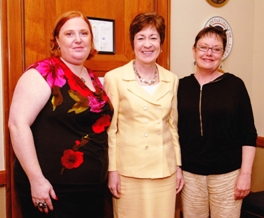
On Tuesday, May 7, as the summit culminated, Laurel and Bethany had the honor of sharing their experience and knowledge on breast cancer with each of Maine’s Senators and Congressmen in a whirlwind day on Capitol Hill. As a result of those visits, Senator Susan Collins has again agreed to be a lead sponsor of the Senate’s Accelerating the End of Breast Cancer Act, and Rep. Chellie Pingree has signed on to the House version. Find out more at http://www.breastcancerdeadline2020.org/.
photo: Maine Breast Cancer Coalition representatives, Bethany Zell (left) and Laurel Bezanson (right), with Senator Susan Collins